Workspaces
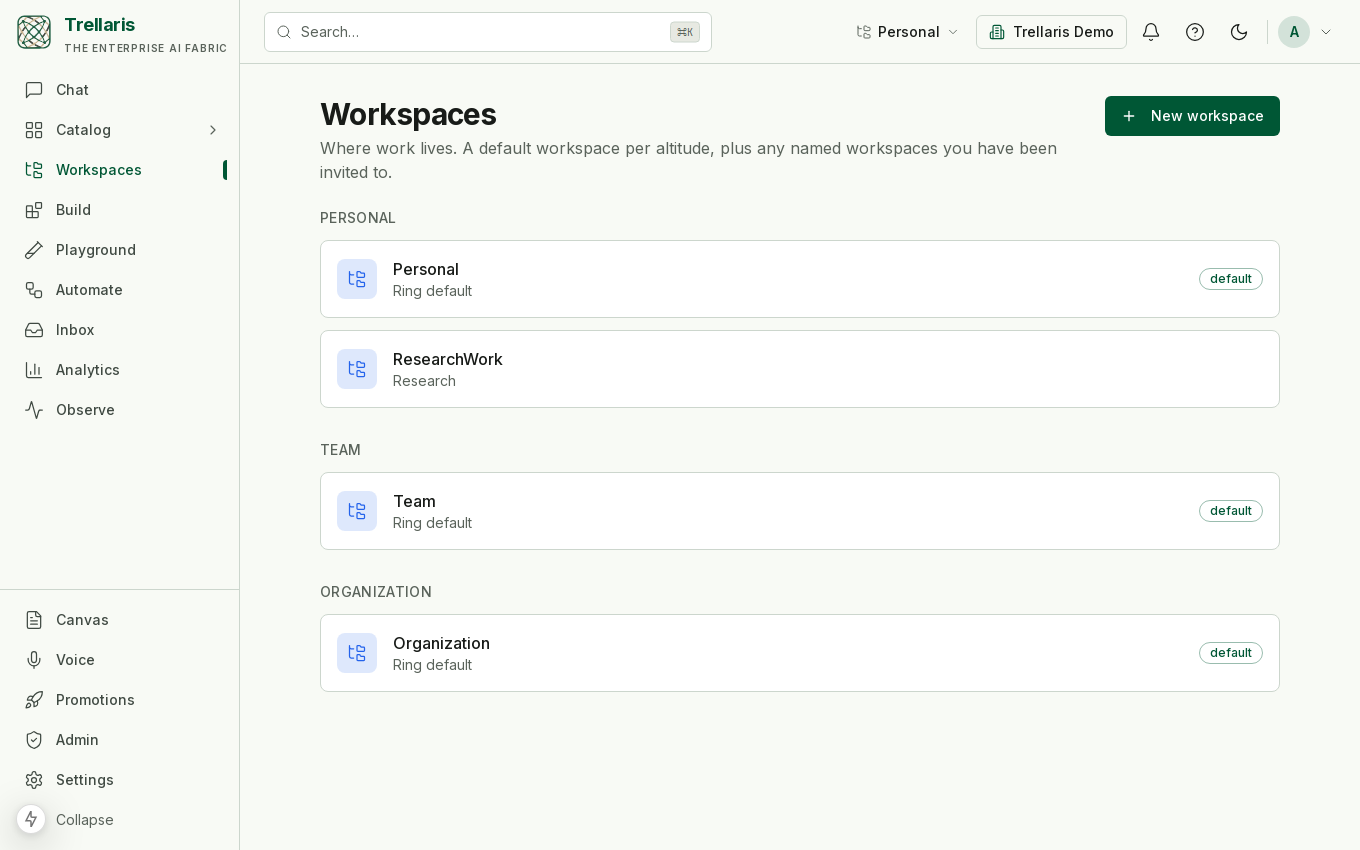
A workspace is where work lives. Every conversation, run, agent, skill and knowledge collection belongs to one — and workspaces are first-class: named, shared, and governed, not just a personal scratch area.
Default and named workspaces
Every user has a default Personal workspace, and every org a default Organization one. On top of those, anyone can create named workspaces — a project space, a team space — with their own membership.
Nothing is unscoped
There is no "no workspace". A conversation or run with no explicit choice lands in your Personal default; picking a workspace in the switcher scopes what you are viewing and pre-fills where new things are created. Crucially, a workspace is never ambient on a write: every creation surface shows the destination as a visible, editable field, so you always know where an agent or a collection is about to be created.
Collaboration surfaces
- Activity — what has happened in the workspace.
- Board — shared items the members are working on.
- Knowledge — collections scoped to the workspace.
- Memory pool — a shared memory written by the
remember_for_workspacetool: a team decision or glossary term, visible to every member, distinct from personal memory. - Members — who is in, and at what role.
Blueprints and guardrail floors
An org can stamp a new workspace from a blueprint — a manifest of starter agents, skills, seed policies, settings and member roles — so a new team space starts governed on day one. A blueprint can set a policy floor: a minimum strictness a narrower scope may tighten past but never loosen. Setting a floor is org-admin-only, and there is deliberately no break-glass bypass.
Stage-gated processes
A workspace can declare an ordered list of stages (for example draft → review → live); entities inside it carry a stage, and a transition runs the gates that already exist — a scan, an eval, an approval — chosen per stage. Absence of a process is the single implicit stage, so untouched workspaces behave exactly as before.