Observability
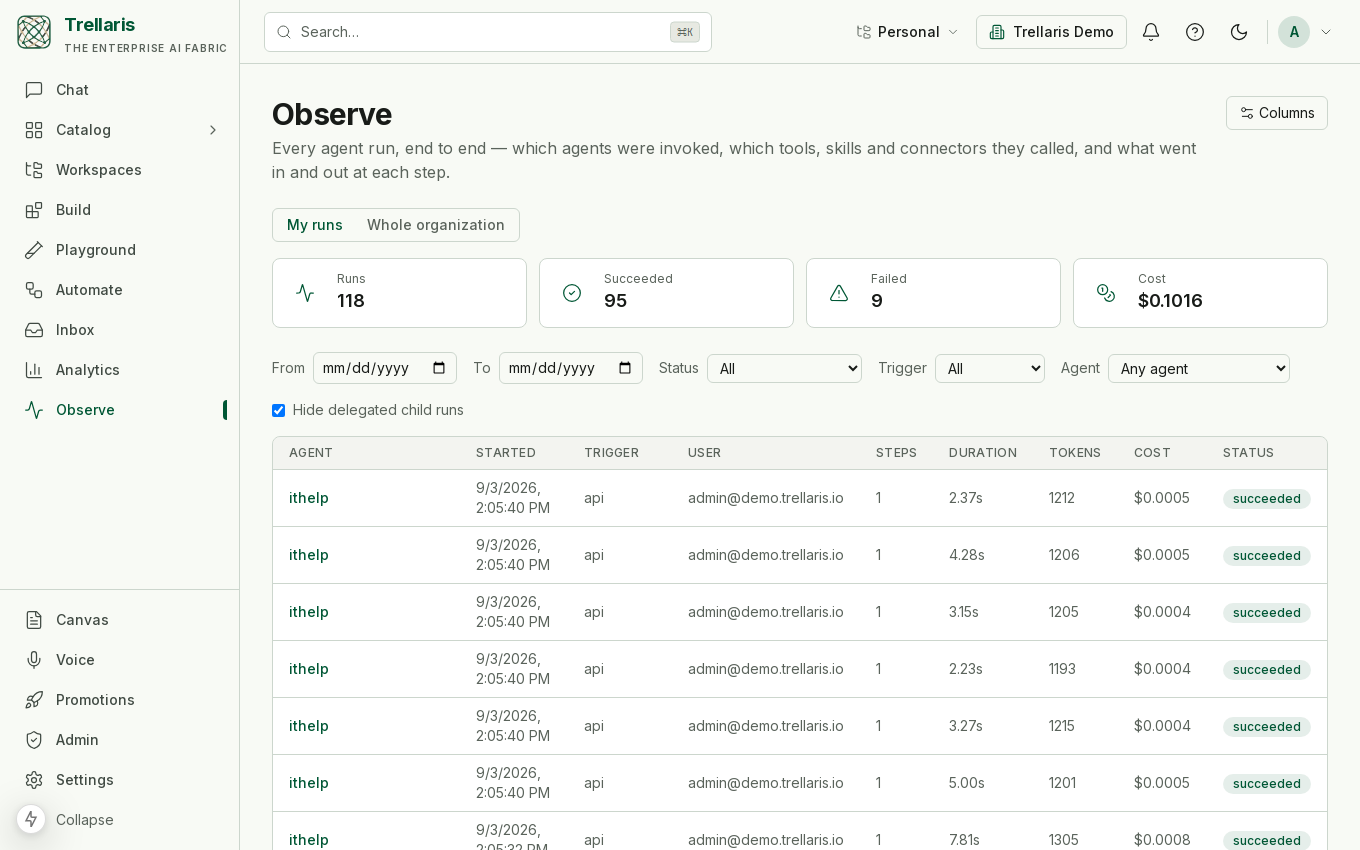
Observe lists every agent run you are allowed to see and opens one as a waterfall timeline — agents, model turns, tools, skills, connectors, approvals, and delegated runs, each with its duration and its input and output.
Why a durable trace
The live event stream is full fidelity but expires after about an hour, and stored messages carry tool calls only for conversations, with no timing at all. Neither can answer "what did this run actually do, and how long did each step take?" a day later. So every run also writes a durable set of span rows in its own transaction — the trace survives long after the live stream is gone.
What a trace records
Each step is classified once and carries its timing and outcome:
- Agent — the run itself, and any delegated child runs it spawned.
- Model turn — one call to the model; the tools it requested nest underneath it.
- Tool / Skill / Connector / MCP tool — each invocation, named after what it actually is.
- Approval and remote delegation — the governed pauses and hand-offs.
The timeline is a tree: a tool call nests under the model turn that requested it (recorded, never guessed from ordering), and a delegated child run nests under its parent. Every node collapses.
Content is post-DLP and truncated
A step stores its input and output after DLP redaction, truncated — Observe is not a second, less-governed home for the same text. When the live stream is still open, Observe also offers the token-level replay alongside the durable trace.
Who can read a trace
| Caller | Sees |
|---|---|
| The run's owner | The full trace, including step input and output (post-DLP). |
| A colleague in a shared workspace | Runs in that workspace; the mine scope narrows to your own. |
| Another member | 404 — a run they may not see is never even confirmed to exist. |
| An org admin | The shape — the same metadata the admin run list already exposes — with input and output withheld unless the privacy tier permits it (a legal hold, or the highest tier). |
Reading someone else's trace is governed by the same privacy-tier rules as the rest of the platform, not a new decision.
Finding a run
The run list filters by date range, by agent, and (for an admin looking org-wide) by user, and paginates newest first. Every row shows who ran it. Retention follows the org's conversation-retention window.
Settings
Settings → Observe carries two owners on purpose. Columns and page size are personal. Whether a step captures its input/output payload is an org-level switch, admin-only — turning it off keeps the span (kinds, timings, outcomes) and drops only the stored content. It is not retroactive.